TRL The Retellable Leader
0 of 6 complete
Curated by Bill Wolfe6 essential talksAbout 2 hours

Make your idea
easy to carry.

The best leadership idea is useless if it stops with you. This short course teaches you to shape a message people can understand, remember, and retell.

Watch six talks.
Try six small moves.
Build one story that travels.

I watched the long list. This is the short one. No lectures from me, no sprawling dashboard, and no busywork—just the strongest material in the order I believe makes it useful.

Your path

One idea.
Six moves.

  1. 01Find the whyGive the idea meaning.
  2. 02Build the storyMake us care what happens.
  3. 03Create movementTurn contrast into momentum.
  4. 04Make it stickUse detail and emotion with care.
  5. 05Make it heardDeliver it like a human.
  6. 06Think on your feetCarry the idea into real life.

The course

Watch. Notice.
Try one thing.

That is the whole method. Each lesson gives you one talk, a few things worth noticing, and one move to apply to the same real idea throughout the course.

01 / 06

Meaning before mechanics

Find
the why.

18 min · Simon Sinek / TEDOpen original ↗

Why this is firstPeople repeat meaning before they repeat detail. Start by locating the belief underneath your message—not a slogan, but the reason the audience should care.

Watch for

  • How the Golden Circle puts purpose before product.
  • The difference between explaining what and inviting belief.
  • Where a simple repeated pattern makes the idea portable.
Try this

Finish this sentence in plain language:

“This matters because _____.”
Companion toolDuarte’s Audience Needs MapPut your why inside the audience’s world. ↗
02 / 06

Tension creates attention

Build
the story.

19 min · Andrew Stanton / TEDOpen original ↗

Heads up: this talk contains some graphic language.

Why it comes nowOnce the idea has meaning, it needs a human shape. Stanton shows why a story is not a list of events. It is a promise, a tension, and a change the audience helps complete.

Watch for

  • The “make me care” test.
  • Why the audience should be allowed to connect some dots.
  • How a character’s choices reveal what matters.
Try this

Find one true moment when someone faced a choice. Tell only:

Situation → choice → consequence → meaning
Go deeperPixar in a Box: The Art of StorytellingA free, hands-on story course. ↗
03 / 06

Contrast creates movement

Create
momentum.

18 min · Nancy Duarte / TEDxEastOpen original ↗

Why it comes nowYou have meaning and a story. Now shape them into movement. Duarte’s “what is / what could be” rhythm turns a static explanation into an invitation toward a different future.

Watch for

  • The repeated movement between present and possible.
  • Why the audience—not the speaker—is the hero.
  • How the ending makes the new world feel real.
Try this

Write three honest contrasts:

“Today _____ . Imagine if _____ .”
Companion readPublic Narrative: Self, Us & NowConnect your story to a shared choice. ↗
04 / 06

Specific beats generic

Make
it stick.

18 min · David JP Phillips / TEDxStockholmOpen original ↗

Why it comes nowA well-shaped message can still be forgettable. Study the practical techniques here as creative tools, while treating broad scientific claims as prompts to investigate—not shortcuts to certainty.

Watch for

  • How concrete moments create mental pictures.
  • The way emotion changes attention and recall.
  • Why ethical storytelling never manufactures stakes.
Try this

Replace one abstract phrase with a moment people can see.

Not “we struggled.” What happened, where, and to whom?
Go deeperHubSpot: Business StorytellingMore practice applying story to business. ↗
05 / 06

Presence without theater

Make
it heard.

10 min · Julian Treasure / TEDOpen original ↗

Why it comes nowYour idea is shaped. Delivery should reveal it, not decorate it. Treasure offers simple vocal tools and a useful reminder: how we speak begins with how we relate to the listener.

Watch for

  • The habits that make listeners withdraw.
  • How pace, pitch, volume, and silence change meaning.
  • The relationship between credibility and care.
Try this

Record your story twice. On the second take:

Slow down. Mark three pauses. Land the final sentence.
Companion toolToastmasters Story EvaluationUse an outside lens on your delivery. ↗
06 / 06

Real life is unscripted

Think on
your feet.

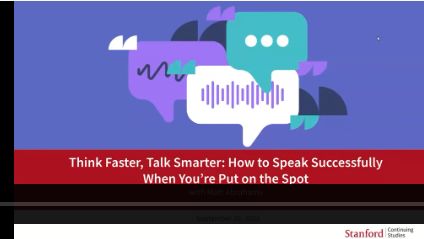
Title frame from Think Faster, Talk Smarter with Matt Abrahams Watch on Vimeo
Matt Abrahams / Stanford Continuing StudiesOpen video in a new window ↗

Why this is lastLeadership communication rarely ends when the prepared talk does. Questions, resistance, and unexpected moments test whether you can carry the core idea without clinging to a script.

Watch for

  • How structure reduces the pressure to be brilliant.
  • Ways to lower anxiety and stay present.
  • Why concise answers make the central idea easier to retain.
Try this

Ask someone for the hardest honest question about your idea. Answer with:

Point → reason → example → point
Companion readCommunicating Amid Constant ChangePreserve clarity without pretending certainty. ↗
Your one useful finish line

Tell the story.
See what travels.

Give your finished five-minute story to three people. Twenty-four hours later, ask each person to retell the point in their own words.

1

Could they name the central idea?

2

Did they keep the meaning accurate?

3

Did they know what happens next?

If yes, your idea travels. If not, return to the first place their retelling broke down.